Detail
ADVANTAGES OF XLPE INSULATED CABLES
-
Does not soften beyond the normal range of conductor operating temperatures and is called THERMOSETTING insulation.
-
Due to greater capacity to withstand heat, the permissible maximum continuous conductor operating temperature is 90ËšC and for momentary short circuits the permissible temperature is 250ËšC.
-
Higher insulation strength and superior mechanical properties allow lower insulation thickness.
-
XLPE insulation dissipates heat from conductors much faster as its thermal resistivity is 3.5ËšC m/W.
-
Volume resistivity is much higher than PVC. i.e. >10 15 Ω cm.
-
Heat generation in the insulation itself is low due to very low “loss angle”.
-
Due to the foregoing reasons, an XLPE cable can carry 15% to 30% higher current than a PVC cable with the same conductor size.
-
Density of XLPE is 0.92 to 0.94 g/cm 3 and due to lower insulation thickness, insulation consumption index is 1/3 of PVC. Therefore XLPE insulated cables are lighter and easier to install.
-
Jointing and terminating of XLPE insulated cables does not require any special techniques.
-
Don’t emit toxic Halogen gases under fire condition.
-
More resistance to oil, acids and alkali.
-
Longer operation life due to more resistant to stress cracking.
SPECIFICATION & CONSTRUCTION
CONDUCTORS
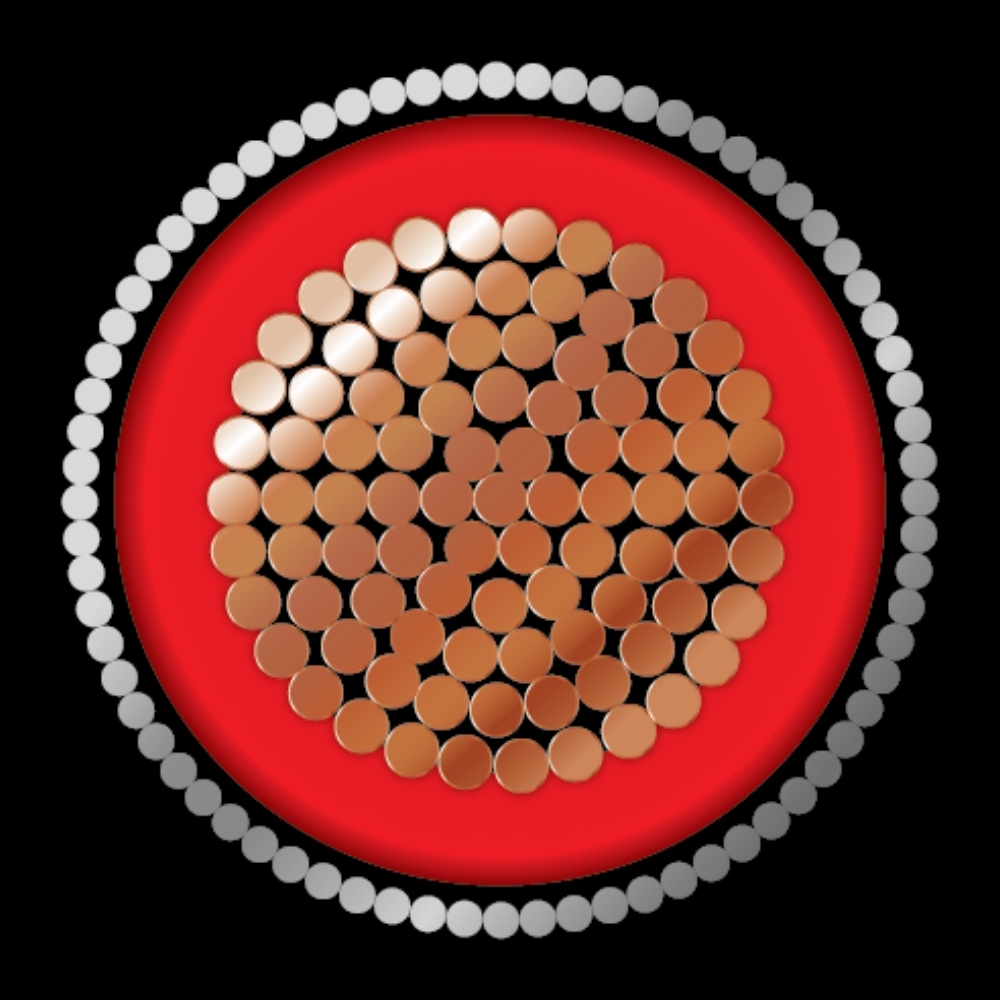
A conductor is the metallic part of cables that is carrying the electric current.
Material of Conductor could be:
- Plain annealed or tin coated copper conductor (ASTM B49)
- Aluminum (to ASTM B233)
The conductor structure is complying with the requirements of BS EN 60228 (IEC 60228).
Conductor can be solid, stranded, non-compacted, circular compacted or compacted sector shaped depending upon requirement.
INSULATION
Each core conductor is insulated by extruded Cross Linked Polyethylene XLPE complying with IEC 60502-1. The insulation thickness is selected based on the designated voltage rate complying with IEC 60502-1 & BS 5467 suitable for 0.6/1.0 KV.
ADVANTAGES OF XLPE INSULATED CABLES
-
Does not soften beyond the normal range of conductor operating temperatures and is called THERMOSETTING insulation.
-
Due to greater capacity to withstand heat, the permissible maximum continuous conductor operating temperature is 90ËšC and for momentary short circuits the permissible temperature is 250ËšC.
-
Higher insulation strength and superior mechanical properties allow lower insulation thickness.
-
XLPE insulation dissipates heat from conductors much faster as its thermal resistivity is 3.5ËšC m/W.
-
Volume resistivity is much higher than PVC. i.e. >10 15 Ω cm.
-
Heat generation in the insulation itself is low due to very low “loss angle”.
-
Due to the foregoing reasons, an XLPE cable can carry 15% to 30% higher current than a PVC cable with the same conductor size.
-
Density of XLPE is 0.92 to 0.94 g/cm 3 and due to lower insulation thickness, insulation consumption index is 1/3 of PVC. Therefore XLPE insulated cables are lighter and easier to install.
-
Jointing and terminating of XLPE insulated cables does not require any special techniques.
-
Don’t emit toxic Halogen gases under fire condition.
-
More resistance to oil, acids and alkali.
-
Longer operation life due to more resistant to stress cracking.
SPECIFICATION & CONSTRUCTION
CONDUCTORS
A conductor is the metallic part of cables that is carrying the electric current.
Material of Conductor could be:
- Plain annealed or tin coated copper conductor (ASTM B49)
- Aluminum (to ASTM B233)
The conductor structure is complying with the requirements of BS EN 60228 (IEC 60228).
Conductor can be solid, stranded, non-compacted, circular compacted or compacted sector shaped depending upon requirement.
INSULATION
Each core conductor is insulated by extruded Cross Linked Polyethylene XLPE complying with IEC 60502-1. The insulation thickness is selected based on the designated voltage rate complying with IEC 60502-1 & BS 5467 suitable for 0.6/1.0 KV.